Hey all! Welcome back to another article. I hope your week is going well. About me, I’ve had a few wonderful stories to share with you — about a job interview that I had applied for. In the final round (HR) the story went twisty in many ways. I’ll share it another day.
I’ve been so concerned about editing my resume. Up until last week, I was using Canva to make my resume. When I think about it now, feels like an extreme normie.
Before we start, the video version of the same is linked at the end of this post. Okay, basically, I have this PDF file generated from the website. If I want to make changes to it, I would go into the site and edit it. Over time, I felt it was so weird.
I had this idea to write my resume in Markdown, but it felt super ugly to me — no proper alignment, etc. But I took the time to do it. All we need to do is, take the PDF, use any tool to convert a PDF to Markdown.
Once i had my resume in Markdown, i saw this project
.Basically, this Python script is converting our Markdown file to HTML and then to PDF using Chrome’s --print-to-pdf option which can be done from any script using chrome --headless. In short, any headless software is capable of working without a graphical user interface. So, here you’re accessing chrome functionalities from cli/scripts. Read more from here.
Firefox does have a headless mode, but I was already set up with Chrome’s workflow. This may not be surprising to you. You could use all sorts of HTML stuff in your Markdown file, because it is essentially converted to HTML and all such HTML stuff will be applied. See i use <center> tag for example.
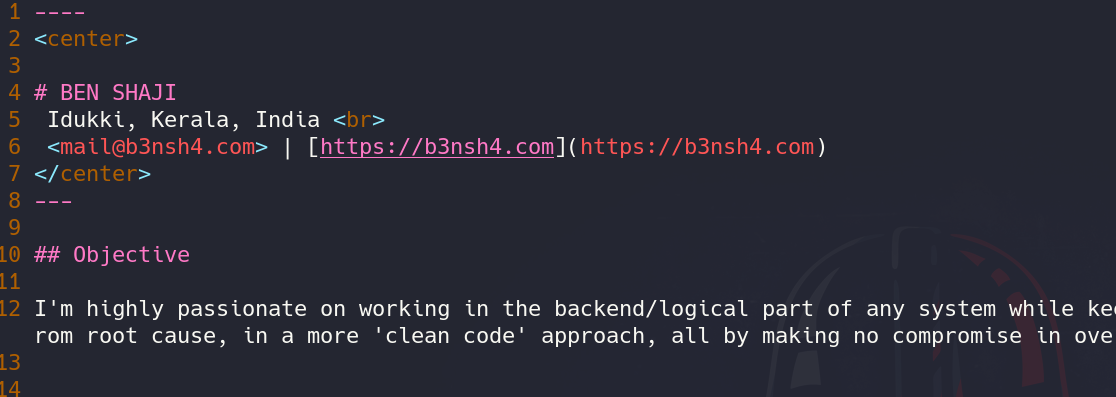
Anyways, I forked that repo and felt there is too much going on it. So, I made my own version of CSS and modified the script just to make the HTML by applying the CSS. At that time my friend suggested I use Firefox’s print-to-PDF dialog. Surprisingly, it had a lot more options than Chrome’s. We could also use the system’s PDF options to add page numbers and other metadata.
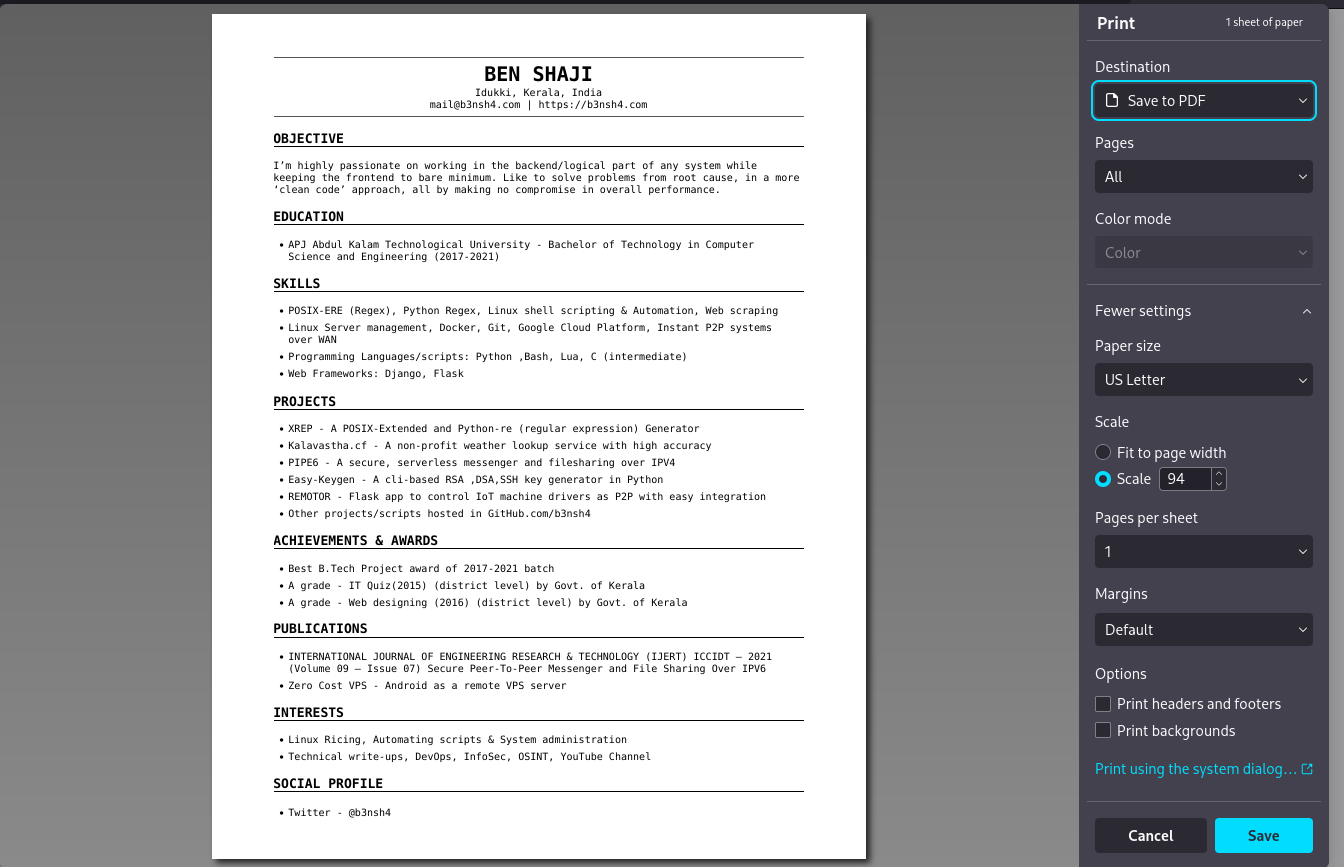
Therefore I made the script so that it only generates the HTML file by applying my custom CSS file. Now, you can choose Chrome, Firefox, or whatever to convert it to PDF. I wanted that flexibility. For me, I like monospace fonts. They take a bit more space, but look tidy. Of course, the best option is something like LaTeX. But I’m just showing the possibility that Markdown + CSS can make minimal and tidy documents.
Finally I made all such modifications and published the final version on my GitHub. I look forward to any suggestions.
Link to the repo github.com/b3nsh4/md-html-converter